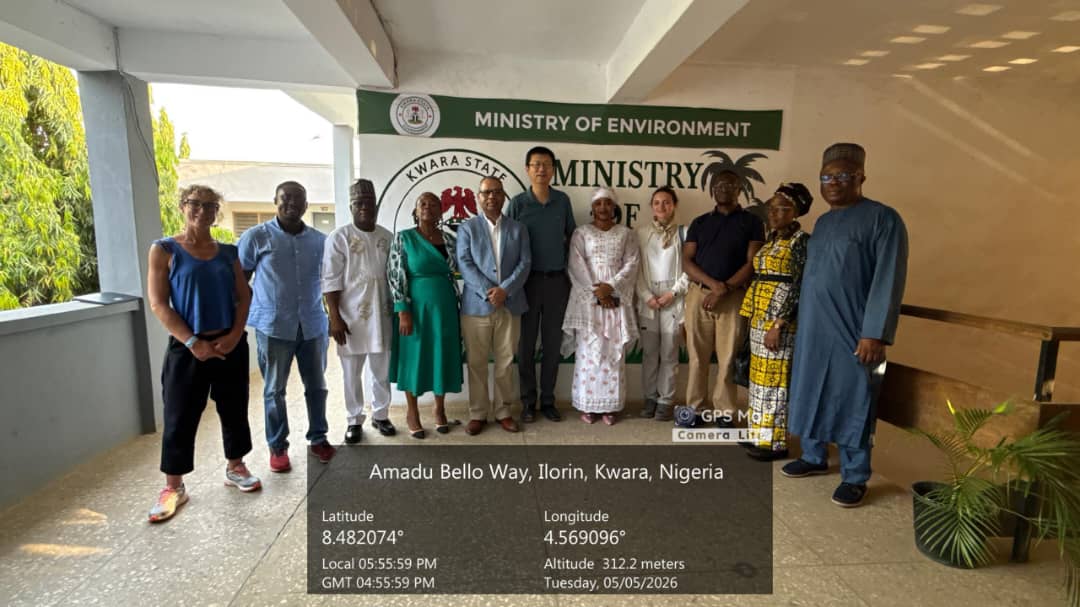
The Kwara State Government has reaffirmed its commitment to strengthening aquaculture and fisheries development through enhanced collaboration with the World Bank, as the World Bank Aquaculture Global Team paid a high-level working visit to key authorized institutions and stakeholders in Ilorin, the State Capital.
The delegation, led by the Global Manager, Environmental Department, Mr. Jiang Ru, on Wednesday engaged with the Commissioner for Environment and Chairman of the State Steering Committee on ACReSAL, Hajia Nafisat Musa-Buge, alongside other key Ministries, Departments, and Agencies involved in water resources, agriculture, and rural development.
Welcoming the team, Hajia Musa-Buge described Kwara State as a strategic fish-producing hub in North Central Nigeria, supplying fish to local markets and neighbouring states, with growing prospects for regional value-chain expansion.
She noted that the state’s aquaculture ecosystem combines modern fish farming systems, riverine capture fisheries, and community-based processing activities.
She explained that while catfish remains the dominant cultured species, tilapia and other fish varieties are increasingly sourced from natural water bodies, reflecting a diversifying production base.
According to her, rural communities remain heavily dependent on traditional fishing and smoking methods, even as private sector investment gradually introduces more structured aquaculture systems.
The Commissioner emphasized that Kwara is currently implementing two major World Bank-supported initiatives, the Agro-Climatic Resilience in Semi-Arid Landscapes (ACReSAL) and the Livestock Productivity and Resilience Support Project (LPRES), which collectively provide a strong institutional foundation for scaling fisheries and aquaculture development.
She highlighted the state’s coordinated, multi-ministerial approach involving the Ministries of Environment, Agriculture, Livestock, Water Resources, and Business, Innovation and Technology, stressing that such collaboration is essential for unlocking the full potential of the sector.
Also contributing, the State Project Coordinator, Alhaji Shamsideen Olatunbosun Aregbe, reaffirmed Kwara’s commitment to strengthening aquaculture systems through improved coordination, extension services, and sustainable resource management.
He noted that existing World Bank interventions are already enhancing service delivery and community participation across rural value chains.
According to him, structured planning is key to addressing persistent challenges such as feed shortages, limited seed availability, and weak market systems.
He commended the World Bank for its technical engagement and capacity-building support, describing it as critical to aligning local interventions with global best practices.
On his part, Mr. Jiang Ru, leading the World Bank Aquaculture Global Team, commended Nigeria’s aquaculture growth trajectory, noting that the sector remains one of the fastest growing in Africa, with significant potential for expansion if structural constraints are addressed.
He highlighted ongoing sustainability initiatives linked to broader agribusiness operations, including energy efficiency through solar adoption, regenerative agriculture, and nature-positive production systems.
He also referenced climate-focused programmes such as REDD+ forestry interventions and carbon insetting mechanisms aimed at reducing emissions across supply chains.
Mr. Jiang further emphasized livelihood impacts, noting that thousands of smallholder farmers and processors across West Africa are benefiting from capacity-building programmes, improved input access, and technical training that are strengthening food systems resilience.
A key highlight of the mission was the World Bank’s aquaculture knowledge exchange programme, which identified critical sector challenges in Nigeria, including feed shortages, limited genetic improvement in fish seed, weak marketing systems, and underdeveloped value addition.
He stressed the need for stronger public-private partnerships, investment in feed innovation such as insect-based feed alternatives, and improved processing infrastructure to enhance competitiveness and reduce post-harvest losses.
In their respective technical contributions, officials from the Ministry of Agriculture and Rural Development and the Ministry of Water Resources underscored urgent constraints affecting production.
The Agriculture Ministry, represented by Permanent Secretary Mrs. Funke Shokoya raised concerns over severe fish feed shortages affecting production while also advocating for strengthened local soybean production and improved fish seed systems to ensure long-term sustainability.
Similarly, the Ministry of Water Resources, represented by Permanent Secretary Mrs. Christiana Omolara Asonibare emphasized the central role of water infrastructure in supporting aquaculture, irrigation, and rural livelihoods.
She noted that effective water management remains essential for sustaining fish production and agricultural productivity across the state.
She also highlighted ongoing coordination with fishing communities and water user associations to ensure equitable resource distribution and environmental balance.
The World Bank delegation commended Kwara State’s integrated governance approach, noting that strong coordination between environment, agriculture, and water sectors provides a solid foundation for sustainable aquaculture expansion.
The visit also included a technical engagement with private sector stakeholders, including Olam Group, as part of broader field learning and knowledge exchange on scalable aquaculture models, feed innovation, and climate-smart food systems.
The mission concluded with a shared commitment to deepen collaboration, strengthen institutional coordination, and accelerate investment in aquaculture value chains, positioning Kwara State as an emerging hub for sustainable fish production in Nigeria.
