By Fatima Mohammed-Lawal
The Kwara Government has said the State records the lowest under-five mortality rate in Nigeria (14 deaths per 1,000 live births).
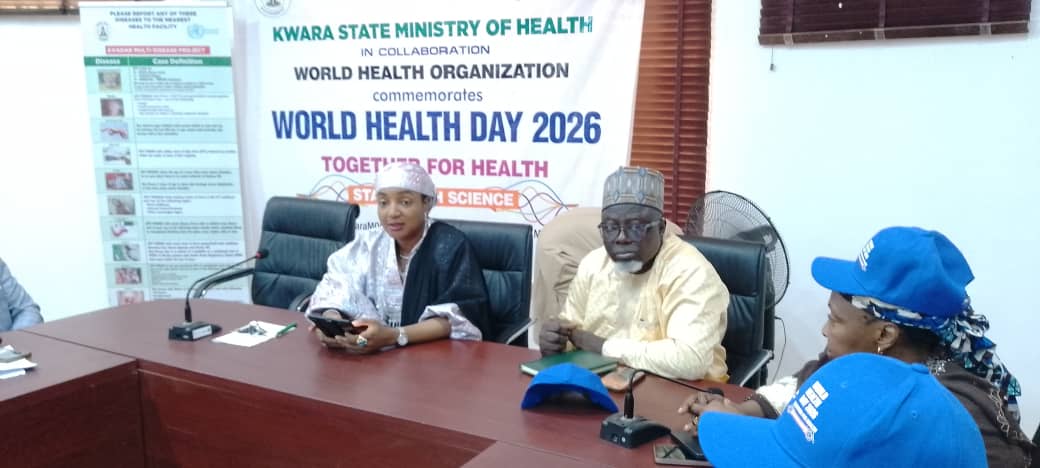
The Kwara Commissioner for Health, Dr Amina El-Imam stated this on Tuesday in Ilorin during a news conference organised as part of the activities to commemorate the World Health Organisation (WHO) Day 2026.
The theme of the day is entitled: “Together for Health, Stand with Science”.
El-Imam described the success as remarkable improvement indicator of improved child survival in the State.
According to her, there is sustained high immunization coverage, significantly reducing vaccine-preventable illnesses.
The commissioner stated that is also recording high utilization of maternal health services, including antenatal care attendance of about 96.8 percent and facility-based deliveries at 77.6 percent.
“These outcomes are not coincidental, they are the direct result of sustained commitment to science-driven policies, primary healthcare strengthening, and community engagement,” she said.
El-Imam observed that the State has recorded notable progress in immunization, nutrition, malaria control, reproductive health, neglected tropical diseases, HIV, and tuberculosis, resulting in measurable reductions in morbidity and mortality.
Similarly, she pointed out that the theme
is both timely and instructive, as it emphasizes the indispensable role of science, innovation, and collaboration in safeguarding the health of humans, animals, plants, and the ecosystems.
“This year’s commemoration marks the commencement of a year-long global campaign that celebrates scientific achievements while promoting stronger multilateral cooperation to translate evidence into effective policies and impactful interventions.
“Central to this campaign is the “One Health” approach, which recognizes that the health of people is closely connected to the health of animals and our shared environment,” she said.
The Commissioner noted that despite the achievement and success recorded, there are emerging challenges.
She listed these to include the rising burden of non-communicable diseases, the impact of climate change, and evolving public health threats.
“This demands sustained investment in science, innovation, and multisectoral collaboration,” she said.
Also speaking, the WHO Regional Director for Africa, Dr Mohamed Janabi, stated that the longer lives, effective prevention and life-saving treatments we value today are the result of decades of scientific progress.
Jannabi who was represented by the WHO representative in Kwara, Dr Emmanuel Eyitayo, said across Africa, science is driving practical solutions that improve lives and contribute to global health.
“African scientists, institutions and communities have played a vital role in shaping responses to major health challenges.
“The rapid development and deployment of Ebola vaccines during outbreaks in West and Central Africa demonstrated the power of research rooted in local partnerships,” he said.
Jannabi added that Genomic surveillance in South Africa enabled the early identification of new COVID-19 variants, informing global responses.
According to him, the region faces a complex web of challenges including persistent diseases, emerging health threats and strained health systems.
He advocated for the “One Health” approach, which promotes coordinated action across sectors to address threats ranging from animal-borne illnesses to environmental risks.
“On this World Health Day, we encourage African governments to increase domestic investment in science, research and innovation as a foundation for health security and sustainable development,” he said.
Earlier speaking, the Permanent Secretary of the Kwara Ministry of Health, Dr Abdullahi Taoheed, emphasised on the need for all stakeholders to collaborate including those in health, veterinary and plants.
