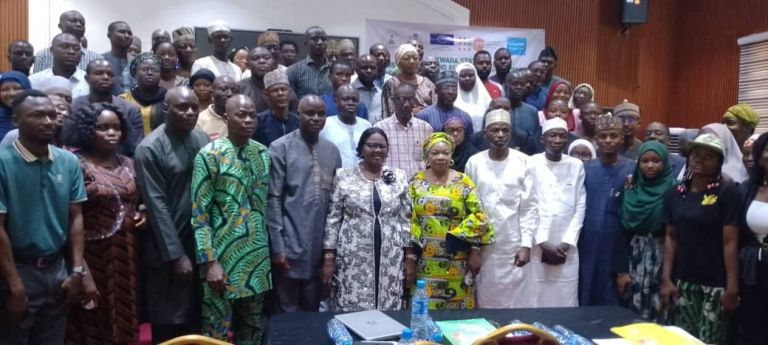
The Kwara Government in collaboration with the United Nations Population Fund (UNFPA) have stepped-up collaboration to convert the state’s youthful population into an engine for economic growth through targeted youth development programmes..
The programme was in collaboration with UNFPA, Kwara Ministry of Planning and Development, and the Health Policy Training and Research Programme (HPTRP), Department of Economics of University of Ibadan.
In her welcoming address, Dr. Mary Arinde, the Kwara Commissioner for Planning and Economic Development, stated that the workshop was aimed at equipping stakeholders with the knowledge and technical expertise.
Arinde spoke at a Three-Day Sensitization and Capacity Building Workshop on Demographic Dividend in Kwara State.
According to her, the required knowledge will help to harness the state’s youthful population for sustainable economic growth and social development.
She reaffirmed the state government’s commitment to leveraging its demographic potential through strategic investments in education, healthcare, family planning, skills development, employment generation and youth empowerment.
“Demographic dividend is the economic and social benefits that can be derived when a larger proportion of the population consists of productive and working-age individuals, with fewer dependents.
“This presents significant opportunities for accelerated development as well as requires deliberate policy actions and sustained investments to unlock its full potential,” she said.
Arinde stated that Kwara stands at a critical point in its demographic transition, with its youthful population presenting both challenges and immense opportunities.
She observed that notable progress has been recorded in maternal and child healthcare, basic education and youth empowerment.
The commissioer, however critical gaps still exist in family planning services, women’s economic participation and labour market reforms.
In her Goodwill message, the Sexual Reproductive Health Specialist, UNFPA, Mrs Gloria Enueze, explained that the programme on harnessing Demographic Dividend in Kwara is funded by the EU-SARAH project, a joint UNFPA/UNICEF initiative.
She commends the government for supporting the initiative, adding that the workshop demonstrates the State’s dedication to sustainable development, inclusive growth, and improved human capital development.
“Demographic dividend refers to the economic growth potential that can result from changes in a country’s population structure, particularly when the working-age population becomes larger than the dependent population. However, achieving this dividend is not automatic.
“It requires deliberate investments in education, healthcare, sexual and reproductive health, youth empowerment, gender equality, job creation, and good governance.
“By investing strategically in adolescents and young people, improving access to quality reproductive health services, and strengthening human capital development, the State can accelerate progress toward sustainable development and prosperity for all,” she said.
Enueze added that UNFPA remains committed to supporting the State in promoting policies and programmes that improve the health and wellbeing of women, adolescents, and young people while advancing the demographic dividend agenda.
Also speaking, Dr Noah Olasehinde, the Acting Director HPTRP programme, Department of Economics of University of Ibadan pointed out that Nigeria has large youthful population and that there is need to find a way to harness the potential of the youth to become productive.
According to him, demographic dividend has four pillars including; health and well being, education and skills development, employment and entrepreneurahip as well as governance and youth participation.
Olasehinde recommended that the government needs to invest in the health of the youth, while ensuring quality education.
“Employment is within the purview of government and they need to also provide enabling environment for the private sector to thrive and employ these youths,” he said.
He also observed the need to create incubation centres on skills acquisition for youth, adding that education must go along with skills for the nations teeming young population.
