Experts and development stakeholders have said that Nigeria’s large youth population holds the key to accelerating national development and boosting the country’s Gross Domestic Product (GDP) if effectively harnessed through entrepreneurship, technology, innovation, and active civic engagement.
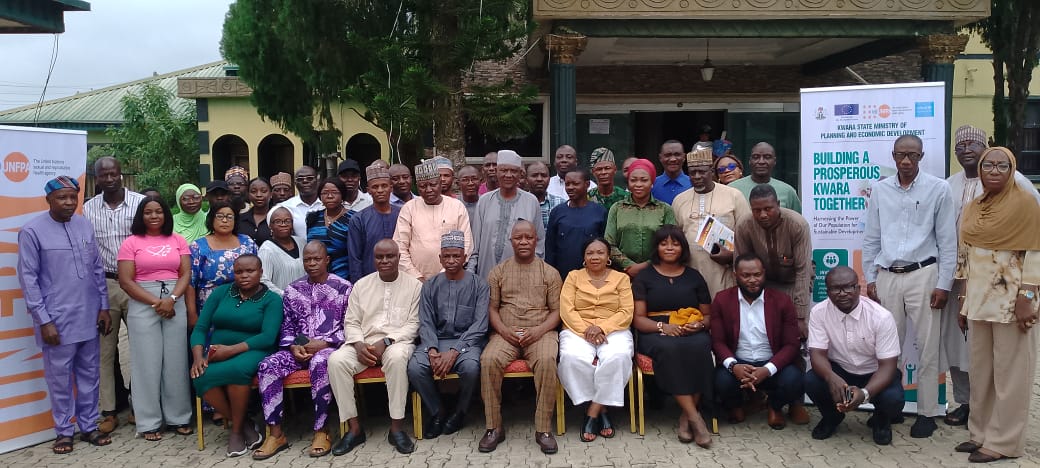
The submission was made at the Five-Day Training Workshop for the Development of a Roadmap on Harnessing Demographic Dividend in Kwara State.
The programme held in Osogbo, was organised at the instance of Kwara Government in collaboration with United Nation Population Fund (UNFPA) and Health Policy Training and Research Programme (HPTRP), Department of Economics, University of Ibadan.
Speaking at the sidelines of the programme, the Kwara Commissioner for Planning and Economic Development, Dr. Mary Arinde stated that 60 percent of Kwara population are children and young people aged 34 years or less.
Arinde who was represented by the Director Planning of the Ministry, Alhaji Ibrahim Barka explained that with the large youth population, the demographic could become the State’s biggest economic asset rather than a burden.
She pointed out that the administration is shifting from seeing youth numbers as a challenge to treating them as the state’s biggest asset.
According to her, there is concerted efforts put in place by the government to equip young people with skills, capital, good health and opportunities that will make them job creators rather than job seekers.
Arinde emphasised on the State’s resolve to turn this demographic advantage into investment opportunities to accelerate sustainable development.
Similarly, the commissioner explained that the programme is all about a roadmap on harnessing the Demographic Dividend (DD).
She added that prior to this, the government has engaged on series of sensitisation workshops on harnessing DD in the State in May and July this year. In addition to this,
“The Kwara Government has launched a Youth Policy and by the time this policy is put to work, the youth would be engaged in meaningful ventures,” she said.
Also speaking, the Assistant Representative, UNFPA Nigeria, Mr Dashe Dasogot stated that the programme is expected to strengthen the capacity of government officials on how to develop a roadmap on harnessing the DD.
He observed that globally, the youth are the greatest assets of any nation, adding that strategies and structures have been put in place to harness DD for the benefits of the nation.
Dasogot pointed out that this is necessary to ensure that the population does not go to waste.
“Harnessing the DD strategy is not advocating for population control, but rather advocating for all tiers of the government to invest in the youthful population.
“Young people need healthcare, education, job creation and good governance to be more productive. We also need data to monitor the progress of these interventions. Sustained investments in this population cohort, will trigger growth in our GDP,” he said.
The UNFPA Official said that in 2017, the African Union (AU) saw the necessity for members states to address the criticality of population in development, and therefore put in place a DD roadmap, and advised all member States to customize it at country level.
Dasogot warned that failure to utilise the potentials of the large population of youth positively may compromise the development, as we are presently experiencing with large unemployment and increasing insecurity.
He insisted that harnessing DD is a strategy to make use of these young people to develop the economy of the nation, citing how the youth are driving technology and innovation globally.
In his remark, Prof. Rasaki Dauda of the Department of Economics, University of Ibadan noted that human capital is critical to growth and development.
Soeaking on the topic: “Concept and Importance of the Demographic Dividend,” the univerdity don said that the destiny lies not in the number of population but also the quality and structure of the quality.
Dauda enjoined all stakeholders including the government, traditional rulers, legislative and academia among others to collaborate and play their part on ensuring and facilitsting the harnessing of our DD.
A total of 56 participants were trained at the programme on the development of a roadmap for Demographic Dividend Estimation in Kwara State.
